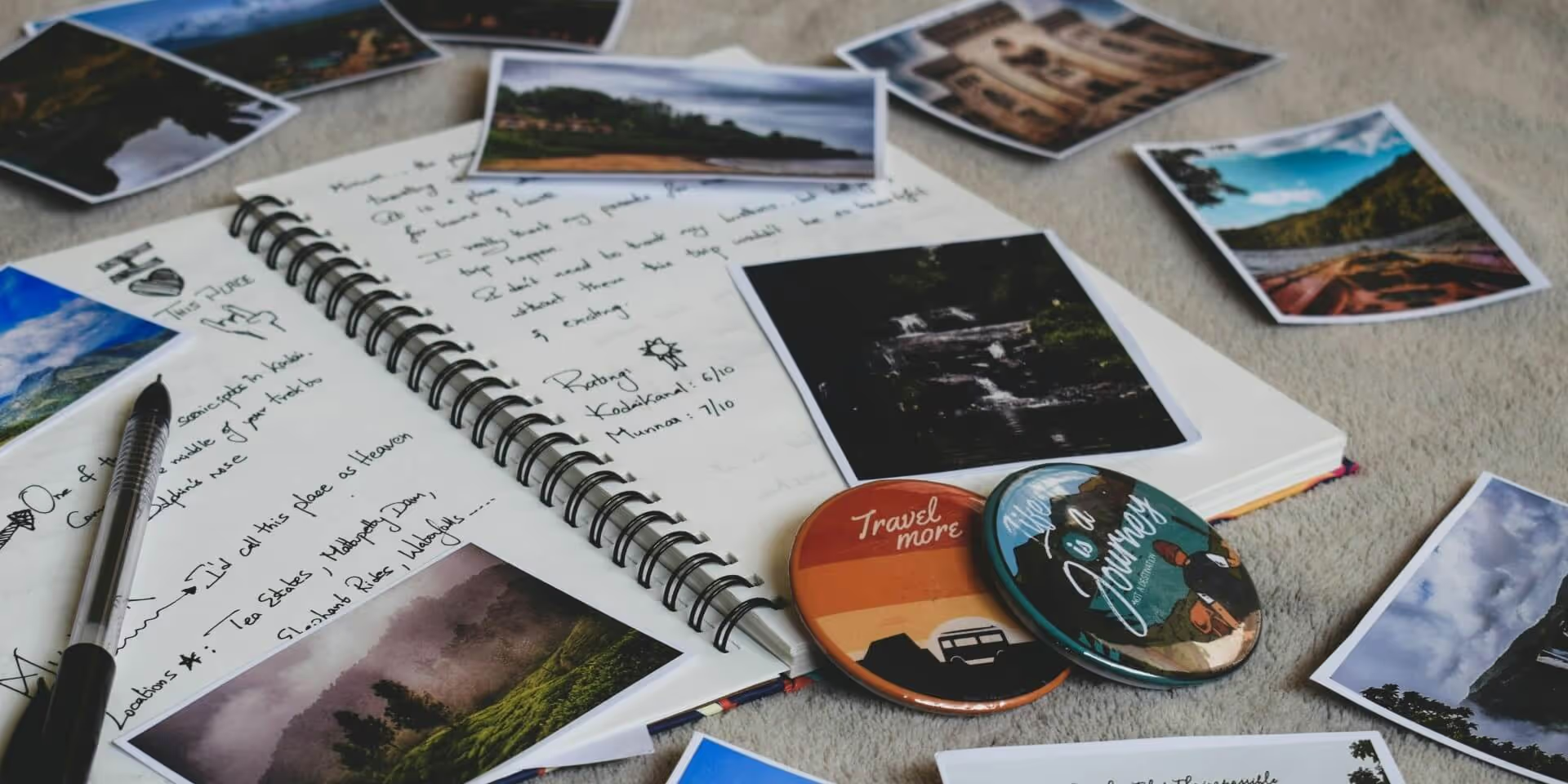
Ask most travel marketing teams whether their photography is doing its job and they'll say yes. The images are high resolution, professionally shot, and on brand. What they won't know is that AI search can't tell their lodge apart from a stock library used by four thousand other websites.
The fix isn't a new photoshoot. It's understanding what AI actually sees when it looks at your existing images, and what it doesn't.
AI search has stopped reading your website as text on a page. It now reads the page as one combined block of words, images, video, and structured data, and it judges all of them together. The part that many travel businesses are getting wrong, the part that costs them the citation, is the visuals.
At Boost Brands, we work with safari operators, tour businesses, luxury lodges, and destination brands across the UK, Europe and Africa. The pattern in client audits is the same almost every time. The copy is good, and the brand is loved. The photography looks beautiful to a human, but is often invisible to a model.
How AI search actually reads your photography
From human eye to machine gaze
Large language models like ChatGPT or Claude do not "see" your homepage the way a guest does. They break each image into a grid of small patches and turn each patch into a vector, then read those vectors alongside the words on the page. The technical term is visual tokenisation, and it means an image is now processed in the same sentence as the headline that sits above it.
That is why image quality has quietly become a technical SEO issue, not just a design one. A heavily compressed or poorly composed image creates "noisy" tokens, and the AI model is more likely to misinterpret what it shows. The Search Engine Land guide to multimodal image SEO walks through this in detail, and the upshot for travel is simple: the better the photo, the more confident the AI is about citing you.
OCR and the text inside your photos
Google Lens and Gemini use optical character recognition (OCR) – the same technology that lets your phone scan a document – to extract text directly from images. Menus, signage, lodge name boards, brochure overlays, or the text on a sundowner cocktail menu in a glossy hero shot – all of it is read by the model and folded into its understanding of the page.
There are real benchmarks for this. Characters need to be at least 30 pixels tall and need contrast of at least 40 grayscale values to be reliably OCR-readable, according to the Search Engine Land analysis. Reflective finishes, script fonts, and faded brochure scans all fail the test, even when they look fine on a Retina screen.
The multi-modal citation gap
This is the number that should make every marketing manager pay attention. YouTube is currently the single most-cited domain in Google AI Overviews, accounting for 23.3% of all citations – ahead of Wikipedia, Forbes, and every text-based publisher on the internet.
For a travel brand, the implication is direct. A service page that combines a clean photo, a behind-the-scenes video, real client testimonials, and structured data outperforms a wall of text every time. Most travel websites still serve the wall of text.

The photography problems unique to travel websites
Stock photography is now an active liability
Generic stock photos confuse AI models and weaken brand recognition. Travel performs better with authentic, real-world photos that build trust and emotional connection. For other sectors, the cost of stock imagery is mostly aesthetic, but for travel, the cost is identity.
A safari brand using a stock image of "Africa" that has appeared on 4,000 other websites is asking AI to confuse it with 4,000 competitors. The model has no reason to treat your brand as the canonical source of that visual, because thousands of other domains used it first.
The "aspirational but unverifiable" problem
Travel photography has a particular aesthetic. Drone shots, golden hour, no people, just a perfectly framed landscape. Beautiful to look at, and almost completely useless to a model trying to understand what your business actually does.
AI search rewards images where the subject is recognisable, the location is identifiable, and the surrounding copy describes what is shown. This is the same logic behind our article on bringing real-life touches to your travel website. If the photo does not match what the guest experiences on the ground, the model cannot verify the claim and the guest feels misled when they arrive.
The brochure leftover problem
Plenty of travel websites are still serving photography that was commissioned for a print brochure five or more years ago. That includes wrong aspect ratios, oversized files, no alt text, no schema, and no AVIF. These are the easiest wins on any travel website audit, and they are also the ones most consistently missed.
Why this matters more for travel than other sectors
Bookings are emotional, expensive, and made before the buyer has ever seen the product in person. Trust is built almost entirely through visuals. If AI search cannot ‘read’ the visuals, the brand becomes invisible at the exact moment a potential guest is deciding who to trust with a £5,000 honeymoon.
What does good look like for travel photography in the AI search era?
Authentic, identifiable, original
Real guests, real guides, real properties, photographed in the actual location with consistent lighting and recognisable subjects. Google's WebDetection API credits the first indexed source of a unique image as the origin, which means original photography becomes a canonical signal.
That signal compounds across the site. When the model knows the photo originated with your brand, it has a stronger reason to associate the visual identity with you the next time a similar query comes around.
Multiple angles of the same property or experience
Photograph each lodge, restaurant, or tour stop from at least three angles. Each angle returns slightly different visual search results, which widens the surface area for citation across Google Lens and similar tools.
A wide shot, a detail, and a guest-perspective shot of the same room will surface for different queries. One image is a single chance to be found, but three is a small library.
Surrounding copy that describes what is shown
The caption, the headline, and the paragraph next to the image should describe its actual content. "Sundowner on the Chobe River at Sanctuary Chobe Chilwero" beats "An unforgettable safari moment". AI models cross-reference the image with surrounding text, and the closer the alignment, the higher the confidence score.
Emotional alignment that matches search intent
Google's Cloud Vision API can score emotional attributes such as joy, sorrow, and surprise on faces in images. For travel queries like "happy family beach holiday in Cornwall," AI looks for images where joy registers as "VERY_LIKELY." Moody fashion-style portraits, which are common on luxury travel sites, can underperform here.

The technical layer most travel sites are missing
File names, alt text, and the basics
Lowercase, hyphen-separated, descriptive file names. So sanctuary-chobe-chilwero-sundowner-deck.webp rather than IMG_2398.JPG. Alt text should describe what is happening in the photo in plain language, including location and subject, because that text is what the model uses as a semantic signpost when it interprets the image. It is also an accessibility requirement under the UK Public Sector Bodies Accessibility Regulations and the European Accessibility Act.
Modern formats, WebP and AVIF
JPEG and PNG are no longer enough. WebP and AVIF deliver smaller files with the same visual quality, which improves Core Web Vitals. AI search deprioritises slow-loading pages, and Google still reports that 53% of mobile users abandon a page that takes more than three seconds to load.
ImageObject, VideoObject, and FAQPage schema
ImageObject schema declares what an image is, who created it, and where it lives. Without it, AI sees a picture. But with it, AI sees a verified statement about a picture.
VideoObject schema wrapping a YouTube embed turns a video into a machine-readable claim with a name, duration, description, and thumbnail. FAQPage schema is the cheapest, highest-return addition for almost any travel page, and is one of the points covered in our article on common AEO mistakes travel brands make.
Image sitemaps for visual-heavy travel sites
Sites with large image libraries, including lodges, tour operators, and gallery-led brands, should submit an image sitemap to Google Search Console. Google's image sitemap documentation covers the format. For a brand with hundreds of property photos, this is the difference between Google discovering the images naturally and Google discovering them quickly.
The travel business fixes to try this week
Audit your top three landing pages
For each one, list which of the four content modes are present: text, images, embedded video, and structured data. Most travel pages will be missing at least two. The hero image alone tells the model most of what it needs to know about the brand, so if that hero is a generic stock shot, it is the first replacement.
Rewrite alt text on the images already there
This is a markup change, not a content change. It can start to count in the same week. Aim for descriptive sentences rather than category labels, and include the property name, the location, and what is happening in the frame.
Add VideoObject and FAQPage schema where the content already exists
If a page already has a video embed and an FAQ section, the schema is two short blocks of JSON-LD. It is one of the highest-return technical changes you can make to an existing page, and it does not require the writer or the photographer to touch anything.
Plan one coordinated shoot day to refresh your top pages
One day of photography and video on a property, tour, or event produces enough material to refresh four to six core pages. This is the foundational asset library decision behind every multi-modal travel page we have built, and the citation lift compounds across the rest of the site once the new images are indexed.
AI can't see what you can see
Many travel businesses are sitting on photography that was built for a different era of search. That is not their fault. The rules changed faster than the marketing budget cycle, and the gap between the brands that adapted in 2024 and the ones still running brochure-era visuals is now wide enough to see from a Google AI Overview.
Visuals are no longer just the part that makes the site look beautiful. They are part of how an AI model decides whether your brand exists, what you actually do, and whether to recommend you to the person planning their trip.
Want to know what AI search currently sees when it looks at your travel website? Boost Brands is a specialist travel and leisure marketing agency. We run focused audits for travel businesses that want to find out exactly where they stand on AEO, which images are helping, which are hurting, and what to change first. If that sounds useful, start a project with our specialist travel and tourism marketing team.
FAQs
Does AI search actually look at images, or just text?
AI search now treats images as part of the page's evidence. Models such as Google's Gemini and ChatGPT's vision capabilities break each image into visual tokens and read it alongside the surrounding text. If your image quality is poor or your alt text is missing, the model has less to go on and is less likely to cite your page.
Will replacing my stock photos really make a difference to AI visibility?
Original photography acts as a canonical signal in Google's WebDetection system, which credits the first indexed source of a unique image. Travel brands using widely-licensed stock photos are competing with thousands of other sites for the same visual identity. Original, identifiable imagery breaks that tie and gives AI a reason to associate the visual with you specifically.
What is the difference between visual search and AI Overviews?
Visual search, including Google Lens, Pinterest Lens, and Bing Visual Search, is when a user searches with an image as the input. AI Overviews is the generative answer block at the top of Google's text search results, which often includes images from cited sources. Both reward the same underlying image optimisation work, but Overviews tends to be the higher-value placement for most travel businesses.
What is multimodal AI and why does it matter for travel websites?
Multimodal AI is a model that can read text, images, video, and structured data together as one piece of content. For travel, this matters because booking decisions are visual: a guest assesses a lodge or a tour by looking at the photos as much as reading the description. Multimodal AI now does the same thing the guest does, which means your visuals are part of your SEO whether they have been optimised or not.
Do I need to add schema to every image on my website?
No. Focus ImageObject schema on hero images, featured images on service pages, and images that appear in galleries on top-performing pages. For VideoObject schema, prioritise any video embedded on a service page or a high-traffic blog post. FAQPage schema is the highest-return addition and should go on any page with an FAQ section.
How long should my alt text be for a travel photo?
Aim for one descriptive sentence of around 10 to 20 words. Include the subject, the location, and what is happening. "Guests on a sundowner deck at Sanctuary Chobe Chilwero, looking out across the Chobe River" is far stronger than "lodge sunset." Avoid keyword stuffing.
What about AI-generated images, are they OK for a travel website?
For travel specifically, authentic photography outperforms AI-generated imagery for trust and emotional connection. Real guests booking real trips want to see real places. AI-generated visuals can work for conceptual or illustrative content, but they should not replace the photography on your service pages or property pages.
How does this connect to AEO and getting cited by ChatGPT or Perplexity?
AEO is the discipline of optimising your content to be cited as the answer in AI search, and our piece on AEO vs SEO for travel brands covers the wider context. Images are a major part of that, alongside text, video, and structured data. A travel page that combines all four on a single URL gives AI models the strongest possible evidence that the page is the right answer to cite.
How quickly will I see a difference if I fix this?
The technical fixes, including alt text, schema, and file formats, can be made in a week and are picked up by AI crawlers within a normal indexing cycle. The strategic fixes, including commissioning original photography and rebuilding service pages as multimodal pages, take longer to commission. Once the new asset library is indexed, the citation lift compounds across every page that uses it.