


We talk a lot in this industry about AI changing how travellers discover operators. Most of that conversation stays at the level of theory. This article is an attempt to move beyond it.
We ran three real planning prompts through the four AI tools most commonly used by consumers today: ChatGPT, Perplexity, Gemini, and Claude. The prompts covered a Tanzania safari, a Patagonia hiking and wildlife trip, and a golf and wine trip to the Cape. For each one, we recorded exactly which operators were recommended, how confidently, and with what reasoning. Then we looked at what those operators actually have in common.
The results are interesting. Not because they tell you who the best operators are, but because they reveal how AI makes these decisions, and what that means for any travel business trying to be part of the answer.
The prompts
We kept the prompts close to how a real traveller would phrase them. Specific enough to reflect intent, but not so technical that only a well-optimised site could respond to them.
Safari: "What's the best safari operator for a first-time couple's trip to Tanzania, mid-range budget, in October?"
Patagonia: "What's the best tour operator for a first-time trip to Patagonia, mostly hiking and wildlife?"
Golf and wine: "What's a good operator for a golf and wine trip to the Cape, only some of the group play golf?"
Each prompt was run through ChatGPT, Perplexity, Gemini, and Claude in June 2026, without any prior conversation context that might influence the results. The responses were recorded in full.
What came back
Tanzania safari
The results here were the most consistent of the three categories. Across four tools, eight operators were named in total, and several appeared across multiple responses.
Several operators appeared across three of the four tools. Suricata Safaris, Gosheni Safaris, Lion King Adventures, and Easy Travel each appeared in three of the four responses. Soul of Tanzania and Safari Soles each appeared in two. Duma Explorer was cited by Claude alone. Gemini was the notable outlier, naming Safari Soles as its top pick and making no mention of Suricata. But Gemini's choices did overlap significantly with the other tools on operators like Lion King Adventures, Easy Travel, and Soul of Tanzania.
ChatGPT safari top recommendation

Claude safari top recommendation

Perplexity safari top recommendation

The tools were also broadly aligned on context and pricing, coming together on a mid-range private safari figure of roughly USD $350–500 per person per day, and on October as a strong month for wildlife viewing in the northern Serengeti.
Patagonia – hiking and wildlife
Two operators came out clearly across multiple tools: Swoop Patagonia, cited by all four tools, and Wilderness Travel, cited by Claude, Gemini, and Perplexity. Both were treated as the primary recommendations in most responses. Cascada Expediciones and its EcoCamp property also appeared in three responses – ChatGPT, Claude, and Gemini – making it the third most consistently recommended operator in this category.
Below that, results diverged. ChatGPT recommended Say Hueque and G Adventures alongside Swoop. Gemini went deeper into niche specialists, naming Natural Habitat Adventures and Far South Expeditions – operators that neither ChatGPT nor Claude surfaced. Perplexity kept its recommendations tight, naming only Swoop and Wilderness Travel before stopping.
Intrepid Travel appeared in two responses, which is interesting. It is a large global operator, not a Patagonia specialist. Its appearance suggests that when AI has less confidence in the specialist field, it may default toward well-known brands with broad digital footprints.
Golf and wine – Western Cape, South Africa
This category produced the most fragmented results. Across four tools, ten different companies were recommended, with very little overlap between tools.
Cape Golf and Wine Tours was the only operator to appear in more than two responses, named by ChatGPT, Claude, and Perplexity. Golfbreaks also appeared twice, named by Claude and Perplexity. Beyond those two, the results were almost entirely fragmented. Claude named Premier Africa and PerryGolf. ChatGPT named Cape Wine and Leisure Tours and Cape Winelands Tours. Gemini named a different set again – Matko Golf Travel, Ascot Tours, and Golf South Africa – none of which appeared in any other tool's response. Perplexity named Cape Golf and Wine Tours, Fairways to Africa, and Golfbreaks, but framed its answer as a starting point for further research rather than a confident shortlist, encouraging the reader to compare operators before committing.
The contrast in results for this prompt versus the safari and Patagonia prompts was stark. Where those categories produced clear frontrunners with some consensus across tools, the golf and wine results read more like four different answers to the same question.
What the results reveal
The three categories produced three quite different patterns. Reading across them tells you more about how AI actually works than any single result would.
In safari, review volume is doing a lot of the hard work
The safari results show a market where AI tools are drawing from the same underlying sources and arriving at broadly similar conclusions. Four operators –Suricata, Gosheni, Lion King Adventures, and Easy Travel – each appeared in three or more responses. That level of consistency across independent tools is not a coincidence.
None of these operators have exceptional websites in content terms. What they share is scale on third-party platforms. Strong review volumes on SafariBookings, consistent TripAdvisor presence, and listings across multiple booking aggregators. Suricata, for instance, has over 3,000 reviews averaging 4.9 stars on SafariBookings alone.
AI tools are clearly drawing from these platforms as heavily as they draw from operator websites, possibly more so when review data is abundant and consistent.
In a market like Tanzanian safari, where many operators have similar-looking websites and broadly comparable copy, review volume across verifiable third-party platforms appears to be the significant differentiator in what AI chooses to recommend.
The implication for safari operators is that your own website matters, but so does the ecosystem around it. A thin or inconsistent presence across SafariBookings, TripAdvisor, and Google is harder for AI to recommend confidently, regardless of how strong your actual product is.
In Patagonia, content depth is the differentiator
Swoop Patagonia dominates the Patagonia results, and the reason is fairly clear once you look at their website. They have built what is, in practical terms, one of the most comprehensive specialist travel resources available in English for this region. Dedicated guides on packing, currency, photography, accommodation choices, and wildlife. Extensive FAQ content, a blog archive, staff credentials, and specific verifiable proof points. The “400,000 hours of lived experience in Patagonia” claim, which appears consistently across the site, is exactly the kind of concrete, extractable statement that AI tools can cite with confidence.
This is the result of sustained investment in content that answers the questions a first-time Patagonia traveller would actually ask, structured in a way that AI can read and repeat.
The contrast with the safari category is also interesting. In safari, third-party review volume drives visibility. In Patagonia, where the operator landscape is less well-documented and aggregator data is thinner, the operator with the deepest and best-structured own-site content wins.
In golf and wine, the market has a content problem
The fragmentation of results in the Cape golf and wine category is not really a story about the AI tools. It is a story about the underlying content. Several of the operators named have websites that are thin by any measure. They have outdated copy, no FAQ content, no structured itinerary detail, and no verifiable proof points. For example, one of the most-cited operators appears to have last updated their site around 2016.
When AI has limited, inconsistent, or poorly structured content to draw from, its recommendations become unreliable. Perplexity's decision not to name any operator at all is probably the most honest response to that situation, and a clear sign of an under-reported travel sector. The tools that did name operators were effectively making recommendations that sounded confident, but on a weak evidential base, which is its own kind of problem for a traveller trying to make a decision.
The lesson for operators in this sector is that the bar to get cited is lower here than in safari or adventure travel. A website that answers specific questions clearly, maintains a consistent presence across review platforms, and uses structured content to explain exactly what it offers would stand out significantly in a field where most competitors have done none of those things.
What all three categories have in common
If we set the categories aside and look at the operators who appear most consistently across all the results, we find they do share a small number of characteristics.
First, they have specific, structured content on their own websites. Not generic marketing copy but direct answers to the questions a real traveller would ask, like what is included, who is it for, what does it cost, and when does it run.
Second, they have a consistent and verifiable presence across the platforms AI reads. Review volume on relevant aggregators. Consistent information across Google, TripAdvisor, and any booking platforms they use. There is no conflicting data between sources.
Third, they use concrete proof points rather than superlatives. “4.9 stars from 3,000 reviews” gives AI something to extract and repeat. A more generic “World-class experiences” does not.
The operators who are invisible in these results are not necessarily worse at what they do. In fact, in several cases, looking at their actual reputations in the market, they are not. They are simply harder for AI to read, verify, and recommend.
The good news is that gap is not unchangeable. It is a content and platform problem, and that can be fixed.
How you ask matters as much as what you ask
One thing that became clear running these prompts is that the specificity of a question shapes the quality of the answer significantly. Our three prompts were deliberately written to reflect how a real traveller plans a trip, with some detail, a clear purpose, and a defined constraint or two. That level of specificity produced usable, reasoned responses across all four tools.
A vaguer version of the same question produces a different result. “What's a good safari in Tanzania?” returns broad, generic recommendations with little reasoning behind them. Add “first-time couple, mid-range budget, October” and the tools sharpen considerably. They filter by season, explain the migration timing, distinguish between private and shared departures, and give budget guidance. The more context a traveller provides, the more AI has to work with.
This has a direct implication for operators. AI is not just reading your website and deciding whether to recommend you. It is matching your content against the specific parameters of the question being asked. An operator whose website clearly answers “who is this for, when does it run, and what does it cost” is more likely to be cited in a specific prompt than one whose content is written for a general audience with no defined traveller in mind.
The AI tools’ behaviour around follow-up questions was also interesting.
ChatGPT follow ups

Claude follow ups

Perplexity follow ups
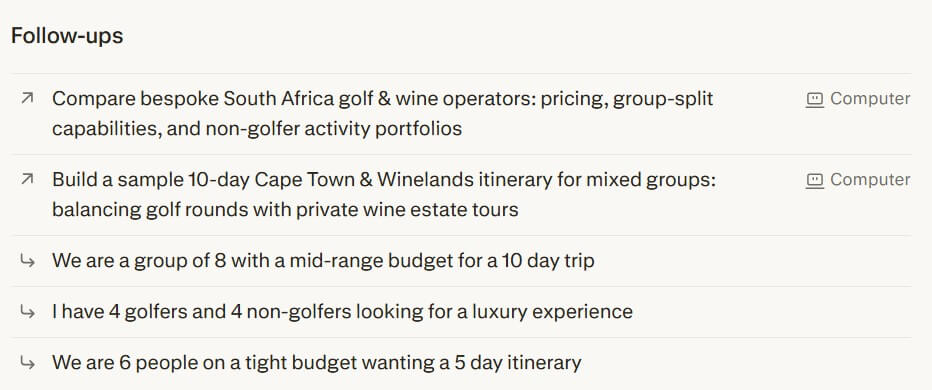
Claude tended to ask clarifying questions before finalising its recommendations, like group size, budget range, and approximate trip length. ChatGPT did the same at the end of the golf and wine response. This conversational behaviour is becoming more common as AI tools move toward a planning assistant model rather than a simple answer engine. It also means that a traveller who engages in a back-and-forth with an AI tool is likely to arrive at more specific recommendations than one who accepts the first response.
A note on the tools themselves
The four tools we used – ChatGPT, Perplexity, Gemini, and Claude – behaved differently enough that the differences are interesting to know.
Gemini went deepest on niche and specialist operators, particularly in Patagonia, surfacing names that none of the other tools mentioned. If you are a smaller specialist operator with strong own-site content, Gemini appears to reward that more than the others.
Perplexity was the most cautious overall. It named operators across all three categories but consistently framed its recommendations as a starting point rather than a firm shortlist, and named fewer operators per category than the other tools. It was also the most transparent about its sourcing, providing citations linking directly to the platforms it drew from.
ChatGPT provided the most structured and detailed responses overall, with clear reasoning for each recommendation. It framed its answers as practical planning advice rather than simply a list of names, and was the only tool to proactively offer itinerary detail and budget breakdowns unprompted across all three categories.
Claude was the most clear about trade-offs, frequently explaining why it suggested shortlisting an operator and what to consider before booking. It also asked follow-up questions in two of the three responses – group size, budget range, trip length – before finalising recommendations, which reflects a more conversational planning approach.
None of the four tools is definitively right or wrong in the operators it names. What they collectively reveal is a picture of who has made themselves legible to AI, and who has not.
What to do with this
The patterns across these results have given us an idea of where you can improve your travel operator's AI visibility, regardless of category.
Audit your third-party presence before you touch your website
In the safari results, especially, review volume on aggregator platforms appears to carry as much weight as own-site content. Check that your SafariBookings, TripAdvisor, and Google Business Profile listings are complete, accurate, and consistent with each other. Conflicting information across platforms gives AI less confidence in your data and makes it easier to overlook you.
Make your website answer specific questions, not just describe your product
The operators who appeared most consistently have content that answers who a trip is for, what is included, what it costs, and when it runs. If a page on your site says “luxury experiences in stunning surroundings” but cannot answer those four questions directly, AI has nothing to extract. Our guide to writing for AI search covers how to approach this in practice.
Add FAQ content to every key page
This is the single most direct structural improvement you can make for AI visibility. Not generic questions, but the real questions your ideal traveller asks before they book. Answer them in two to four clear sentences on the relevant page. Our article on FAQ schema for travel websites explains the technical side.
Use concrete proof points
Specific, verifiable claims like star ratings with review counts, awards with years, or certifications with issuing bodies are what AI can repeat. Vague claims about quality are invisible to it.
Think about the full planning conversation, not just the opening query
As AI tools have become more conversational, travellers are asking follow-up questions that drill into their specific situation. An operator whose content only addresses the broad category question will drop out of the conversation as it gets more specific. Content that answers the second and third questions a potential client might ask will keep you in the picture.
Test your own visibility regularly
Run the prompt a traveller would use to find you. Do it across at least two tools. Note whether you appear, what is said about you, and how it compares to what your competitors are being recommended for. The gap between what you would want AI to say and what it actually says is where you can improve your content.
AI visibility in travel is not yet a settled market. In several of the categories we tested, the bar is lower than operators assume. The businesses that move now are the ones that will be hardest to displace later.
If you want help understanding where you stand and what to prioritise, get in touch.


