

We recently looked closely at the analytics for a website we manage and found something interesting. It is the kind of mistake that could easily happen to any travel business publishing regularly online, and it rarely announces itself while it is happening.
For a few months, new pages on the site were not being indexed. There was no redesign, no migration, no algorithm update. It was simply a step that got missed in the regular publishing process. New posts kept going up, but they were never being flagged to Google as ready to crawl.
We only noticed once we went back through the analytics and found a pattern that did not sit right.
What is indexing?
It is easy to assume that publishing a page and it being indexed are the same thing. They are not.
Publishing a page makes it live. Anyone with the direct link can see it. But it will not appear in Google search results, or anywhere else, until Google has found it, read it, and added it to its index.
The index is essentially Google's catalogue of every page it knows about and considers worth storing. Only pages in that index can appear in search results. A page that has not been indexed does not exist as far as Google search is concerned, no matter how good the content is.
There are a few different ways a new page actually gets submitted for indexing, rather than just sitting on the site waiting to be found.
Most websites automatically generate a sitemap, a file listing every page on the site. That sitemap gets submitted to Google once, and from then on Google is meant to periodically recheck it for anything new. This is the most passive option. If it is working correctly, new pages get picked up without anyone needing to do anything further, though not always quickly.
Alongside that, most content platforms also let you actively flag a specific new page and ask Google to come and look at it straight away, rather than waiting for it to be found through the sitemap or a routine crawl. This is the step most publishing workflows rely on to get a new page noticed quickly instead of slowly.
There is also a separate protocol, supported by Bing rather than Google, that lets a website ping search engines the moment a page goes live. Since AI tools like ChatGPT lean heavily on Bing's index for retrieval, this is an important step for AI visibility specifically, not just conventional search.
If you skip any of these steps, a page can sit published and live, fully readable to a human visitor, while remaining invisible to search and to AI tools. That is the gap that opened up here. Pages were still going live in the normal way. They just were not being actively flagged as new content ready to be crawled, so they were left to be found passively, and much more slowly, if at all.
Indexing is not a small technical detail behind the scenes. It is the gate everything else passes through. Good content, strong keywords, clean structure – none of it counts until a page has cleared that first hurdle.
The pattern that gave it away
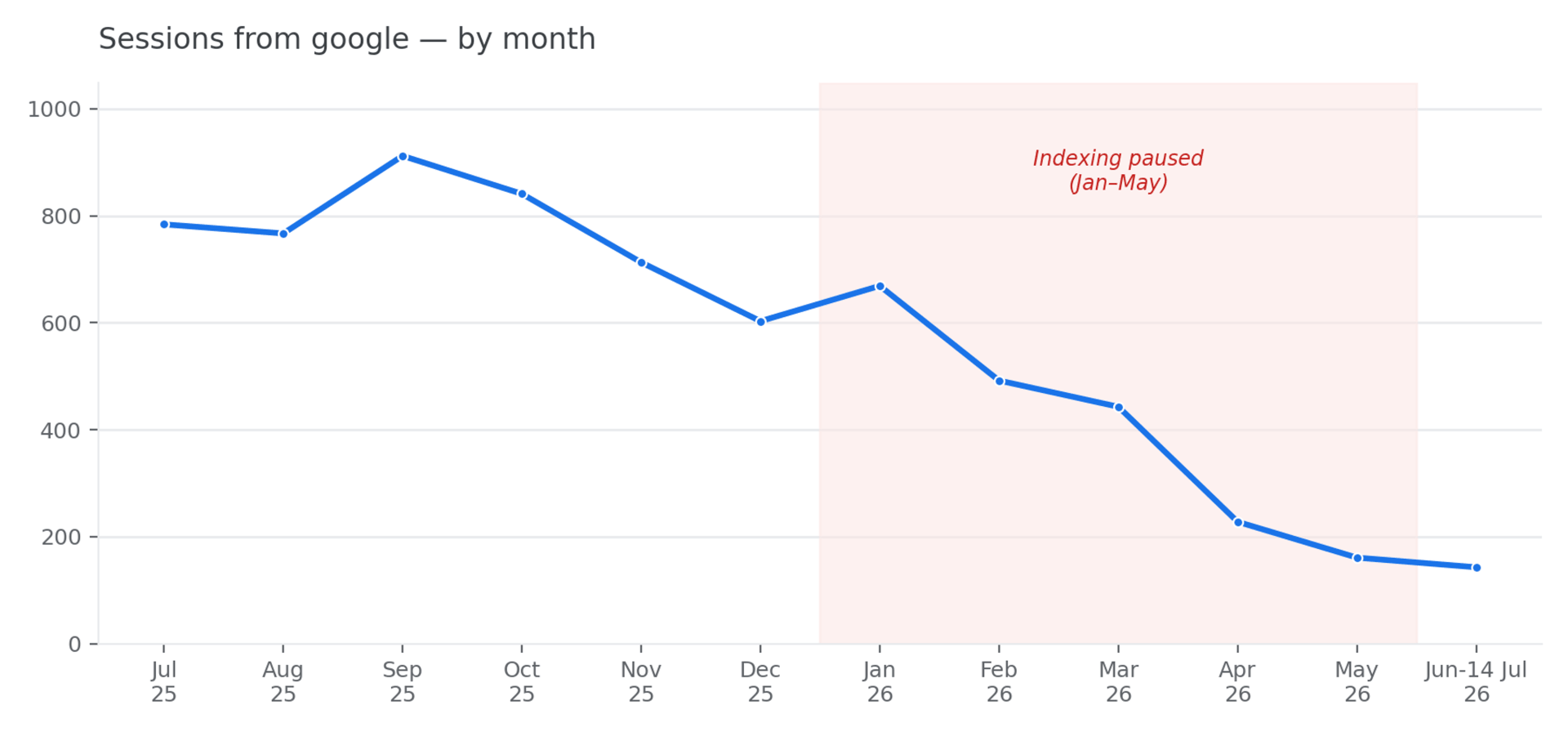
So what did this actually look like in practice? We noticed that traffic from Google had been falling for a while. On its own, that is not unusual. Rankings move, seasons shift, and competitors publish more.
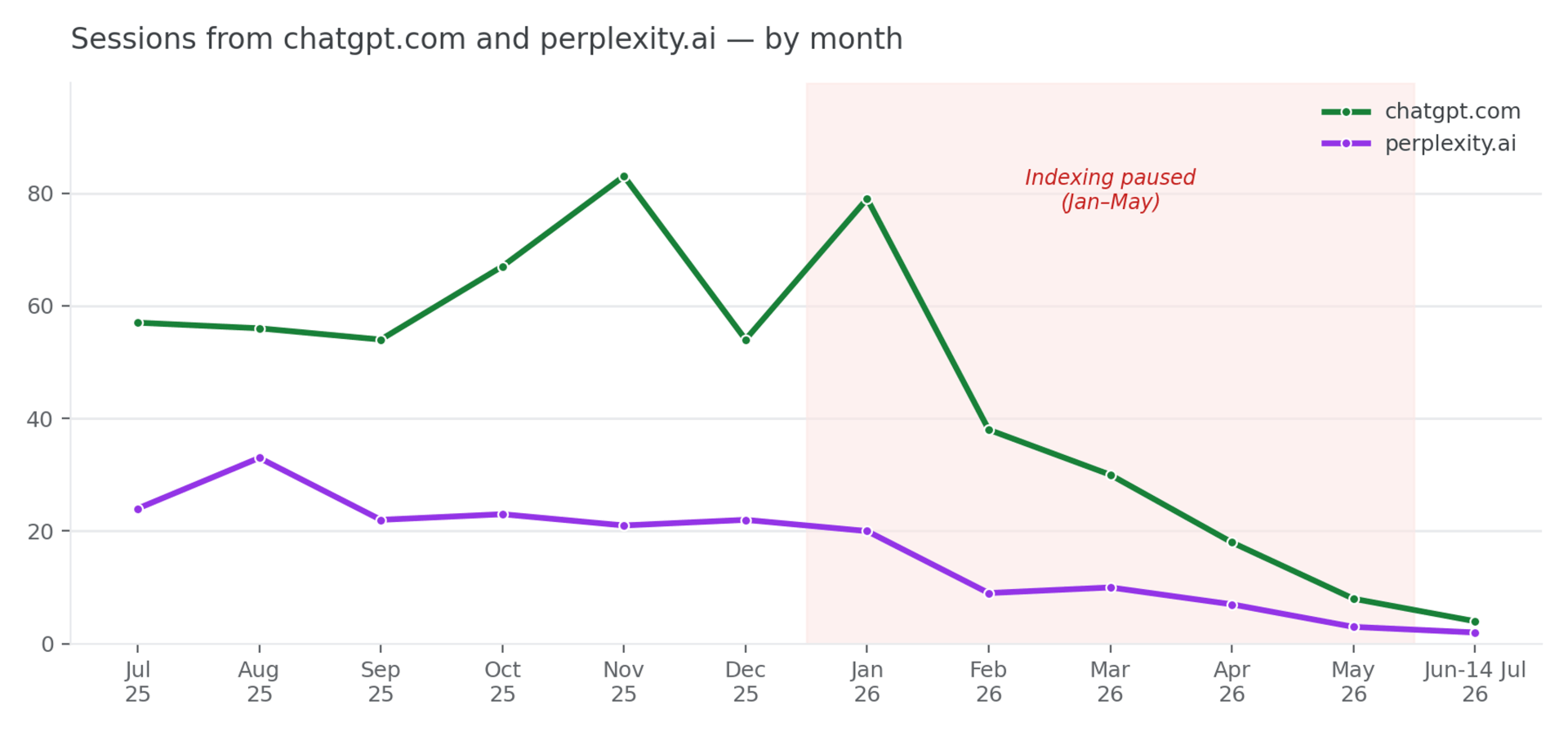
What made us look closer was that traffic from AI tools, ChatGPT and Perplexity in particular, was falling at the same time and in a similar shape.
That stood out. Google search and AI referral traffic do not normally move together like that. If the problem had been specific to Google, a ranking drop from a core update, say, or a competitor outranking the site on certain terms, you would expect the AI tools to behave differently. None of them weigh the same signals in the same way.
Normal Google search relies on its own index, built by crawling and indexing pages over time. ChatGPT leans more heavily on authoritative, widely referenced sources. Perplexity favours fresh, easily retrievable content and runs a live web search for every query. Google's AI Overviews draw from Google's own organic index directly.
If your own traffic has dropped and you are not sure why, our piece on diagnosing a falling traffic line is a good place to start.
The one thing they all depend on: indexing
When channels that normally behave independently move in the same direction at the same time, the cause usually sits upstream of all of them.
Indexing is exactly that kind of issue. A page that has not been indexed can’t appear in ordinary Google search results, and it can’t appear in Google’s AI Overviews either, since those draw from the same index.
ChatGPT and Perplexity work differently under the surface, but they still rely on indexed content as their starting point for retrieval, just with different timing and secondary factors layered on top.
That’s why an indexing gap does not just cost you conventional search traffic. It also closes the door on AI visibility, because both are drawing from the same underlying supply of indexed pages.
What the data showed, month by month
The decline in Google traffic had actually started a little before the indexing gap began, so indexing was not the sole cause of every part of the drop. Something else was already softening performance.
But once new pages stopped being indexed, the decline accelerated, and it accelerated across Google referral traffic and AI referral traffic together, rather than in one channel alone. That is the detail that made the cause easier to isolate. A pre-existing soft decline is one thing. A sudden, simultaneous drop across unrelated traffic sources is another.
Indexing was re-implemented a couple of months ago. And, to be honest, so far, the recovery has been slower than expected. Google traffic has not returned to where it was before the gap, and AI referral traffic remains lower too.
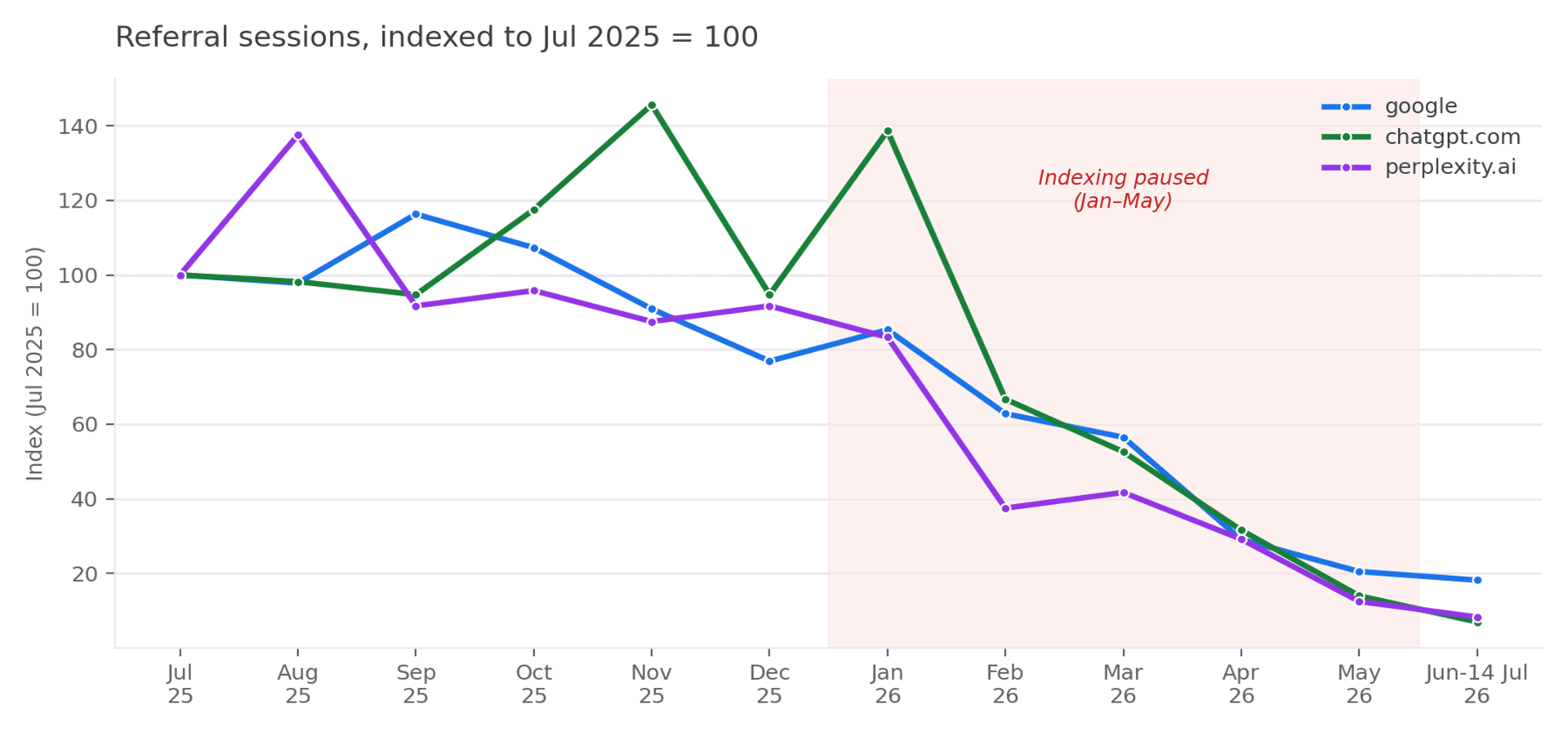
It would be easy to assume that flipping indexing back on fixes things immediately, but the data so far does not support that. Crawlers work through their own schedules rather than reacting the moment something changes. We are continuing to watch this closely.
This is also a useful reminder for any travel brand investing in SEO or AEO that neither works on a switch. Fixing a problem does not produce an overnight bounce, and neither does doing everything right in the first place. Rankings shift gradually, indexing takes time to catch up, and AI tools recrawl and reassess on their own schedules. If you are watching for quick results after a change, whether that is fixing a mistake or launching something new, you are likely to be disappointed by the timeline – even when the underlying work is solid.
What this means for AEO, not just SEO
There is a tendency to treat AI visibility as something separate from traditional SEO, requiring its own distinct tactics: schema, phrasing, structure, and so on. Those things do matter. But this is a reminder that they all sit on top of a more basic requirement.
If a page is not indexed, none of the more sophisticated AEO work has anywhere to attach itself. Getting the fundamentals right, and regularly checking that they are still in place, is more important than layering on newer tactics before the basics are confirmed.
It is also a reminder that AI referral traffic is not immune to the same failure points as conventional search. Because AI tools are newer, it is tempting to assume problems with them must have a more complicated cause. Here, the cause was straightforward and identical across both channels.
A quick way to check your own site
Most travel businesses will not notice an indexing gap until traffic has already dropped for months, simply because nothing about the website looks any different in the meantime. We have certainly learnt the valuable lesson to conduct a quick check every now and then, rather than waiting for a decline to prompt one. Here’s what we’ve instated:
Step 1: Check Search Console's index coverage report
This shows you exactly which pages are indexed and which are not, and flags any that have dropped out.
Step 2: Confirm new pages are being submitted, not just published
Most CMS platforms have a setting or plugin for this. Publishing and submitting for indexing are two different actions, and it is worth confirming both are happening.
Step 3: Watch Google and AI referral traffic together
If both start moving in the same direction at the same time, indexing is one of the first things worth ruling in or out, before assuming the content itself has stopped working.
Don't wait for the decline
This is easy to overlook because it does not look like a problem day-to-day. The website still works. New content still goes live. Nothing about the daily experience of running the site changes, which is exactly why a gap like this can run for months before anyone thinks to check.
If you publish regularly, whether that is blog content, destination guides or seasonal offers, periodically confirm that new pages are actually being indexed, not just published. It costs very little time, but the cost of not checking can run for months, across every channel that matters.
Is your traffic slipping while nothing on the site looks any different? Get in touch and we will help you check whether indexing, or something else entirely, is behind it.
FAQs
Does Google indexing affect AI tools like ChatGPT and Perplexity too?
Yes. Google’s AI Overviews draw from the same index as regular search, so a page that is not indexed can’t appear there either. ChatGPT and Perplexity work differently, but both still rely on indexed content as their starting point, so an indexing gap affects all of them, just with different timing.
How do I check if my pages are actually being indexed?
Search Console’s index coverage report shows you exactly which pages are indexed and which have dropped out or were never picked up. It is important to check periodically rather than assuming publishing alone is enough.
If I fix an indexing problem, how quickly does traffic recover?
Not necessarily quickly. Crawlers revisit sites on their own schedules rather than reacting immediately, so recovery can take considerably longer than the drop did. This is why you should track traffic over several months rather than expecting an instant bounce.